My blog has moved! Redirecting...

You should be automatically redirected. If not, visit http://insearchofnirvana.wordpress.com/ and update your bookmarks.

Wednesday, December 31, 2008

Au Revoir

Tis' the last day of the year. And what a year it was. As some news channel had said, it was a year to forget. The year started with a whimper, and then came the big crash of the stock market. And since then, it has been downhill. Unfortunately it ended with one of the boldest terrorist strikes on Indian soil.

In all this time, I managed to finish 3/4ths of my MBA. Still some more time left before I call myself Master of the Universe. It seems only recently that I had written the post on 1/4ths of an MBA. Yet, it feels like a long time ago. On the road ahead, there are a lot of things to think about, a lot of things to do. Among them I have to decide the future of this blog. I haven't written much lately here. Partly it is because there's not much inspiration left, nor the time with the daily routine of MBA. And even though there are only a few months left for its finish, I somehow feel this blog has completed its purpose.

I've learnt a lot of things in this journey, I've grown quite a bit, especially in the last four years. Yet, the more things have changed, the more they seem to stay the same. It is time once and for all to change permanently the things which are not required, to pick up things which will help you in the future and then carry on the journey. Maybe I'll write here once in a blue moon. Till then, I'll be somewhere thinking up something trying to be somebody.

And let us all hope 2009 is a better year for everyone.

Friday, December 05, 2008

What I learnt in MBA

I had heard of the saying 'You scratch my back, I scratch yours.'
In MBA, I learnt the saying, 'You screw my a**, I screw yours.'

Wednesday, December 03, 2008

Yeh hai meri kahani

Before one year - Hum jahaan khade hote hein, day-0 wahin sey shuru hota hai

Before placements - Bhagwan mainey tumse aaj tak kuch nahin maanga.....

During the interview,

Me - Main is resume per haath rakhkar yeh saugandh leta hoon ki jo bhi kahoonga sach kahoonga, aur sach ke siva kuch nahin kahoonga.

Interviewer - I-Bankers ke bayaanat aur sub-prime ko madde nazar rakhtey Taz-e-raat-e-hind, dafaa 302 ke tahet , muzrim ko 5 lakh ki pagaar di jaati hai

Me - Maa, me 5 lakh ka MBA banne wala hu

Mom - Yahi din dekhne ke liye maine tujhe paal pos ke bada kiya tha? Ab hum kisi ko muh dikhaane ke layak nahin rahe

(Prospective) Father in Law - Haraamzaadey! Teri itni himmat! Meri beti par dorey daalta hai! Teri haesiyat he kya hai? Is ghar ke darwaaze, tumhare liye hamesha ke liye band hein

Dost (IIM waley) - Maine tumhe kya samjha, Aur tum kya nikley!

Girl friend
- Mai kahti hoon, Door ho jaa meri nazron sey

Doctor - I'm sorry, hum kuch nahin kar saktey. Ab Sab oopar waale key haath mein hai

Faculty - Bhagwaan pe bharosa rakho. Sab thik ho jaiye ga

Thursday, November 27, 2008

One more attack

One more attack happens in Mumbai. Hearing such news has become routine nowadays. The latest attack which happened in South Mumbai, in 5-star hotels and in CST railway station was one of the worst in recent times. This time there were no remote detonated bombs. This time terrorists literally walked in, and started shooting. What were the police doing? CST is just opposite the BMC headquarters. Isn't there supposed to be proper security? The Maharashtra State Police headquarters is at a walking distance from the Taj Hotel. So is the Mumbai Police Headquarters. When will the government learn? How many more lives have to be lost? Has the state devoted itself to kicking out North Indians out of Mumbai? Its time you start kicking the 'right' people out of Mumbai, those who carry out such attacks, not those who come to Mumbai to earn a decent living.

Every terror attack now comes as a predictable sequence of events. The attack happens, the PM condemns the attacks, so does the Home Minister. There is a probe set in. And we await the results. Until the next terror attack. Is the government asking for 'A Wednesday?' The worst thing is that people will hail and salute the 'spirit of Mumbai.' Mumbai will again wake up tomorrow as if nothing had happened. The spirit of Mumai? What a load of bull. It is not the spirit which brings it back to its feet, but apathy. Apathy towards the condition of the common man. The familiar reactions are 'We were not affected by it. Why should we stop going about our daily lives?" "I have 4 mouths to feed, I have to go to work." "Who can postpone the inevitable?" Is this what the spirit of Mumbai is all about? Turning a blind eye to the daily sufferings of fellow citizens.

Tomorrow the spirit of Mumbai should not wake up. It should instead take a long vacation. And it should not come back until the government has taken concrete measures to protect its citizens from such blatant attacks. The whole of India needs to think hard and long, are we safe in our own country? Am I alive today just by luck? Where is the safety of the common man who may get gunned down anytime due to the lackadasial approach shown by the authorities time and again.

Change was required in the US, and the people voted. A bigger change is required here. The message we need to send out to the government is we do not want you to give any condolences. We do not want you to condemn the attack. We want action. Can the government guarantee that?

Updates (Saturday)
* This attack has turned out to be one of the worst and boldest terrorist strikes in the country. It shows yet another glaring failure of the authorities to ensure safety for the common man. The impunity with which terrorist can come and attack any city in the country is shameful on our part.

* The PM has invited the ISI chief to help in the investigations! Cmon which world are you living in? Calling the people who have trained and helped to propagate these terrorists will in no measure help the investigation. The Indian government should stop being diplomatic about it and start calling a spade a spade.

* A sincere salute to the ATS officers, the MARCOS unit and above all the NSG commandos who handled the whole situation with the expertise and competence expected of them. Wish the same could be said for our inept politicians.

Wednesday, November 26, 2008

Desh Drohi - The rise of KRK

Back from an examination paper which didn't go too well (what's new?) So I should most likely be in a mood to unleash my sarcasm on someone. The most likely candidate this time around is the new kid on the block, KRK. I'm sure you've heard of him, or seen the movie trailers doing the rounds on TV these days. He is the hero of the new film Desh Drohi which seeks to send a message of brotherhood and harmony across the nation. And no, its not about LOC or Indo-Pak relations, but about the feud between the Maharashtra Navnirman Sena and the northern states.

For once I won't ridicule anyone. Reasons, political and otherwise, forbid me to do it and I do not wish to turn this into a sarcastic free-for-all. Some say it is a movie worth going to, because it teaches about the importance of being together in these troubled times. Some say the movie is not worth a review. Is KRK a replacement to SRK? Who know, but all said and done, in the eternal words of Jugad Singh, Aadmi sachha lagta hai. (Wish the placement season would be as simple as this)

My friends say there is no comparison between SRK and KRK. But isn't that what people said when SRK came into the scene? SRK vs Amitabh? KRK vs SRK? As Einstein put it, its all relative. He has a long way to go and so here's wishing the fellow all the best in Bollywood. We come in peace.

Sunday, October 19, 2008

Three days

Three days are all you need to understand someone deeply
Three days are all you need to discover their foibles
Three days are all you need to fall in love all over again

Three days are all you need to feel the pain of their tears on your chest
Three days are all you need to see the sad goodbye in the swelled up eyes
Three days are all you need to make the everlasting wait unbearable

Friday, October 17, 2008

From funeral to funeral

Nassim Nicholas Taleb in his book, "Fooled by randomness" writes, "It is said that science evolves from funeral to funeral. After the LTCM collapse, a new financial economist will emerge, who will integrate such knowledge into his science. He will be resisted by the older ones, but, again, they will be much closer to their funeral date than he."

One and only one funeral comes to mind now - the sub-prime crisis, the latest funeral in a long list of never-ending deaths.

P.S. On a related note, MBAs did not cause the sub-prime crisis. We are just not that intelligent.

Definition of an optimist

An optimist is someone who is happy about the weight-loss while sitting in an airplane that is crashing straight down.

Sunday, October 12, 2008

You've come a long way baby

It is often repeated in global business circles that when the US sneezes, the rest of the world catches a cold. But have you ever wondered what happens when the US catches a cold? Judging from recent events, this is what precisely has happened. With the burst of the housing bubble, US has dragged down many other economies of the world. Even the BRIC juggernaut has slowed down.

When did the turn of events happen? When did sub-prime, which was a catch word in B-schools and a hot topic of discussion, suddenly turn into a monster? We have come a long way since last year. A lot of money has since flowed under the bridge. Last September, the sub-prime crisis had just reared its ugly head but no one could have predicted the level to which it has affected every one of us today. Governments are hastily organizing bailout packages for mopping up bad debts. Age old institutions are going off the radar. Investment Banking as a concept has been wiped out.

As far as India is concerned, the decoupling theory was badly routed. India has not been immune to the global hiccup. Inflation reached alarming levels, the pathetic levels of IIP has demoralized the industry and the stock market have seemed to lost all steam. The irrational exuberance which led the Indian stock markets to record highs till January has been squashed. The exuberance has gone; now only the irrationality remains. Newspapers scream valutions at 2005 levels, but who has the courage or the cash to buy today? Judging from the industry scenario, it seems India is heading for a recession with no brakes. And I'm on that train.

P.S. The above is not a rant, nor a crib. Just a dispassionate look on things which have happened and which are in store.

Thursday, October 09, 2008

Of Sardars and Idli

What is the height of frustration?
A hungry sardarji sitting in Murugan's Idli Shop.

Wednesday, October 01, 2008

Is it time to worry yet?

An article I was reading on ZD-Net had this to say about the effect of the global financial crisis on Indian IT firms.

In fact, Premji, one of India's richest men by virtue of his share in Wipro, apparently practices frugality to the extent that he orders 'by-two' samosas in the office café. 'By-two' is a famous local habit, quickly adopted by newcomers, of splitting one order of anything (coffee to soup) between two people to save on costs.


Many of the now bankrupt firms had accounts with the IT giants for developing their IT systems. And since they are no more, the fallout is going to affect the IT industry as well. And here we are being complacent, having McDees and Coke Floats and Subways. Are we being smug about the whole situation? Are we choosing to hide behind a imaginary veil of hope? Has the time to start worrying come yet? Time itself will tell.

Wednesday, September 24, 2008

Recipe for the perfect evening

A light breeze,
Some dark clouds,
Some screaming monkeys,
A hot cup of tea,
A splitting headache,
A half-eaten pack of biscuits.

Add a few things,
Remove a few things,
and you've got a perfect evening.

Saturday, September 20, 2008

7 Laws a manager must remember

1) Murphy's Law

This is arguably one of the best known and widely quoted laws out there. It was named after Captain Edward Murphy, an engineer in the US Air Force who created it in a fit of frustration. In its simplest form, it says "Anything which can go wrong, will". Many of you might have experienced a corollary of Murphy’s Law in daily life while standing in a queue. The queue in which you stand seems to always move the slowest. Although you cannot do much about selecting the right queue, in the world of business a manager can use this law to be prepared. In this day and age of highly complex and interconnected decisions, it is prudent to have a contingency plan (or many) if the one you choose doesn’t work out. Software projects may overshoot their deadlines, demand forecasts may go horribly wrong because of sudden rise in raw material prices, or the marketing campaign which you so carefully thought up of may go haywire because the competitor trounced you with a newer product. As a manager, you are paid to make decisions, and unless you learn to anticipate things which can go wrong, you won’t be making much progress in your career.

2) Parkinson's Law
"Work expands so as to fill the time available for its completion."

This is another law which is quite well-known in the scientific and business community. This was first coined in an article in the Economist in 1955, and time and again it has proved to be true. On the outset, this law simply seems to point that it is important not to procrastinate. A manager is supposed to be efficient in doing his work and in allocating the time required for its completion. But if one digs deeper, one can find out at least two hidden meanings.

One is the principle of budgeting. The actual resources for a project will expand to its budgeted amount. This is a very commonly used practice by functional heads while deciding their annual budget. Rather than improving their department’s efficiency by aiming to cut down on the actual resources used, managers actually allow the bloating of resources so that their forecast looks accurate. Moreover having a higher budget for their department can increase their prestige. An effective manager should instead proactively measure and fight any unnecessary bloating of resources.

The second implication of this law is from the field of Economics. It hides in it one of the basic mechanisms of supply and demand. In the long run, the demand for a product increases to match its supply in order to achieve equilibrium. Although in Economics the reverse is also easily true, once the supply decreases, the demand for that product also decreases (due to higher prices). This is not so easily seen in the business world. If the time available for a project decreases, there is a highly likely chance of it overshooting the old and even the newer deadlines by a significant amount. Thus the Parkinson’s Law enables you to prepare your project plans more carefully.

3) The 80/20 Law

The 80/20 law, also known as the Pareto Principle was actually framed by Juran, one of the leading exponents of quality in manufacturing organizations. This law has been empirically observed to be true in so many situations that it has become universally applicable. In its most general form, it states that 20% of the causes drive 80% of the consequences. In a business environment, it can be applied to many situations - 20% of the employees do 80% of the work, 20% of projects will take up 80% of the resources, 20% of the employees get 80% of the salary(?) etc. A variant of this was even used controversially in GE by Jack Welch to categorize employees into three bands. He exhorted the organization to make the top 20% “feel loved.” Application of this law can help a manager to find out which resources are costliest, which customers are most valuable, which employees are hard-working and thus focus resources on these important causes.

4) Hurst's Law
Complexity can neither be created nor destroyed. It can only be displaced.

This law parallels an oft-repeated adage, "Problems cannot be solved." For every problem you solve, there arises at least one problem equal in complexity to the 'solved' problem. Business consultants would do well to keep in mind this law. Armed with a heap of tools and techniques, consultants work to re-engineer business processes and re-structure hierarchies, promising an effective and efficient organization. But many a times they fail to foresee that the new structure is simply creating new complexities which have not improved the overall condition at all. Managers grappling with supply chain issues can also keep in mind this law to ensure the proper flow of information and resources. The entire value chain needs to be looked as a whole to ensure that the complexity is not simply shifting within the organization. They should instead find ways how it can be actually shifted out of the system.

5) Parkinson's Law of Triviality
Organizations give disproportionate weight to trivial issues.

Anyone who has been in a meeting that seemed to last forever has come across this law. The frustration multiplies when your bosses are the ones who guide the meeting and you're but a pawn in the meeting. A very common tendency of managers is to jump into the problem immediately without structuring or organizing the facts first. By not spending time to understand the requirements, one tends to pick up the most obvious problem that comes across and work towards solving that first. But the most visible problem may not be the most important. Following this approach proves to be very wasteful in terms of both time and resources. A manager should keep this caveat next to the Pareto Principle in importance and ensure that by assigning priorities to the problems in front of him, he can apply his resources in the right order and in the right proportion.

6) KISS principle
Keep it simple, stupid

The importance of being precise is constantly hammered by B-schools into students. However a mistake which most newly-minted managers make is to confuse precision with verbosity. Managers are made the butt of many jokes on how they use complex words and phrases even for describing something simple. Thus, “we sell toothbrushes” may turn into “we provide complete oral hygiene”.

Though it is important to be precise to prevent errors, such precision should come from simplicity. As Einstein said, any fool can make things bigger and more complex. It takes a touch of genius and lot of courage to move in the opposite direction.

Saying that your organization engages in continuous value creation may look good in mission statements but a manager should be able to simplify things. Not in a way to leave out any particular detail, but so as to be able to explain the 4Ps or Maslow’s hierarchy to a 4-year old child. Spouting out management jargons may impress your peers at the annual industry seminar but will always leave your subordinates confused after they come to you for clarification.

7) Unintended consequences
Any action taken purposefully will produce some unintended consequences.

This is a law which parallels Murphy's Law, but unlike its more famous counterpart, this adage actually allows positive side-effects. This may ensure that a company may find a new use of a previously scrapped product because the government has changed regulations or even the fact that getting fired from a job gave you a chance to develop that entrepreneurial spirit in you.

Although possibly apocryphal, the story of how 3M failed in its quest to develop super glue and instead created one of the most useful inventions in history – the Post-it note is proof enough of this concept. Another example of this law at work in the business world is Adam Smith’s invisible hand concept. An individual aiming to better his interests may actually produce certain consequences which were totally unintended in the beginning. This law ensures that a manager keeps in mind that there could be results which no one has thought of before. He can then take steps to minimize the damage as much as possible. Of course if the side-effect is positive, a manager can claim the action to be intended and well thought of.

The obsolete 6pm rule

Nowadays post-mortems can be conducted even in the dead of the night.
- Professor, Strategic Marketing.

Pun Intended? :)

Tuesday, September 16, 2008

Sub-prime and buyout blues

Last year, the sub-prime crisis had hit the US home mortgage sector. Around one year has passed since the term came into fad. A lot of articles have been written, a lot of gyan dispersed on the topic. Even I have had some fun with the sub-prime buzzword. But now it seems the circle has been completed. After Bear Stearns collapsed in March this year, it was the turn of the venerable Lehman Brothers to find a similar fate. However there were no takers for the institutions. BoA has agreed to buy Merill Lynch, so such saviour for LB. The financial crisis which we made a lot of fun of last year has come back to haunt us. Though the financial sector has been the worst hit, there will definitely be a trickle down effect in other functions, IT, marketing etc.

The financial system seemed to be in a dire need of a catharsis and recent events seem to have helped in the cleansing. Now it remains to be seen whether the ruins of the financial sector can be cleared in a few months time or is it time to sit at home wondering what to do with an MBA degree? My optimistic (naive ?) self says that the rubble will clear. So it is time to be prepared. It is time to fire up all cylinders, even if there seems to be no road ahead.

Friday, August 29, 2008

Cchange forrtunes througgh numerology

It's official now. Alternative career options are coming back with a big banng. After the recent foray of Jawed Habib into hair-cutting schools, Sanjay B. Jumaani (did I get the number of as right?) is planning to open a numerology school where he plans to teach eeager students the art of adding, twisting and dropping letters from the nnames of celebrities and movies to supposedly turn around their fortunes. He was the 'engineer' behind the naming of the hugely popular movie 'Singh is Kinng', though it remains to be seeeen whether that was the reason why the movie was actually successful. Like a true businessman he says that currently this market is largely unorganized and thus there is a huge potential for such business.

In my opinion, it was ok when you changed the spellings of names of movies or actors. It's their personal choice on how they want to spell their name. My English teacher in school used to tell me that you can pronounce proper nouns any way you like. But what gets to me is the uninhibited way they change the spellings of English words to suit their numerological beliefs. Isn't there any such thing as good grammar? Thus we have names like Singh is Kinng, Heyy Babyy and C Kkompany. Well, Bbollywood cannot be bothered with such petty issues. As long as the film doesn't have any content, the sstrange sounding name won't worsen it anyhow.

One more business opportunityy I missssed. Dammnn.

Saturday, August 16, 2008

Laundry woes

Why the last laundry person ran away...

Saturday, August 09, 2008

Lose control

Have you ever experienced that feeling while riding a bike when suddenly your wrist twists a little more than it should? The bike lurches forward, and for a moment you feel totally out of control of the bike, like it is taking you where it wants, not where you want it to go. Immediately you catch hold of yourself, forget everything else and loosen your grip on the accelerator to get back in control of your bike.

While riding a bike the blip on the radar screen disappears but momentarily. Now replace the word 'bike' with another four letter word 'life'. How difficult (or easy) is it to gain control now? Here you're driving on a crowded highway. Here there is not an inch to take or give. The blip this time stays missing for a longer time. So what happens? You crash into people. That is how conflicts arise. That is how fights happen. That is how people get killed.

Riding a bike with no brakes is not a good idea, so is life.

Wednesday, August 06, 2008

Drawing - an old hobby

Trying to revive an old hobby of mine. Who is this character? Please rate.

Synchronized dudeness

Patting strangers on the shoulder and blurting out 'Chill dude' can be injurious to health (and possibly CGPA) if the stranger turns out to be a professor! :)

Friday, July 11, 2008

Hair-cutting schools

Jawed Habib has opened a hair-styling academy in my home town, Vapi. Now, I would consider opening a saloon would be logical but opening a training school for hair-cutting? In Vapi? I didn't know there were so many budding barbers in this town! After 12th standard, forget engineering, MBA, MBBS. Give the HAT (Hair-cutting Aptitude Test) and join the academy. According to an ad of his, the world needs more Jawed Habibs. Wondering how many will he find in Vapi?

But consider the following statements:-
* Hairstyling is the career of the century.
* The beauty saloon industry is growing at a rate of 40% and is around Rs 1500 crore.

Here are some back of the envelope calculations I actually had the time and craziness to perform...


As I passed through the academy today, another thought crossed my mind. I wonder how do they give training to the students? I mean the theory would be straight-forward, but what about the lab sessions? Where do they get volunteers to try their hair-cutting skills on? I wonder which is more scary - going under a medical intern's scalpel or under a barber-trainee's scissors?

For me going to a hair-saloon as fancy as this is like visiting a fancy Italian restaurant - I never know what to order. I prefer the IIT Madras saloon kinds where there is no need of a menu. Medium or short. That is it. Someday I may have to go to such saloons if a particular some one insists. Well that'll be the day...

Anyway welcome to the city, Jawedbhai H.B.B.S. Your presence in the city means that my small town is expanding and I have a good business opportunity here.

Sales v/s after-sales service

It has been my general experience that there is a wide chasm between the budget allocated for sales and that for after-sales service. Most people would argue that after-sales service is a part of marketing and that according to marketing gurus, marketing starts well before the product is developed and continues well after the consumer buys the product. A standard textbook definition. But in real life, does a company really focus on that after-sales part diligently? Few companies do so.

Take the case of banks, for example. Private banks nowadays send a representative to your house when you tell them you want to open an account. They help you fill up the new account forms, they take the minimum account opening balance from you etc. But does the bank maintain that level of service once the account is active? When I want to change my address, I have to go to the nearest branch. To reset my ATM pin (when I've forgotten my old one) I have to visit the nearest branch.

The most obvious point of difference is the type of interaction itself. While opening an account, a 'representative' from the bank comes over to your house. While doing other transactions, you are forwarded to a call-centre where after you press (quite) a few buttons, you reach a human at the other end. And what happens then? Even for a simple request, the call-centre 'executive' tells me to visit the nearest branch!

The counter-argument would be that it is because of the security aspect. Banks would like to be sure that they are dealing with a genuine customer before they do a sensitive transaction like closing an account or changing ATM pin or issuing a new ATM card. But its not that personal interaction would get rid of all these problems. We still have news reports of people duping the bank branch by forging a signature while sitting in the bank itself. Investing in technology can be (if the bank wants) justified in terms of providing customer service.

Another major difference seen between these two services is that while one is an integral part of the organization, the other is generally outsourced. Would any company dare to outsource its sales division? No it won't. Yet companies do not hesitate while deciding whether to outsource the after-sales service division. It is less of a headache they say, dealing with irate customers and product returns.

Why can't organizations be more balanced in the level of both these kinds of services? If B-schools have a specialization for sales and marketing, why can't they have a specialization for after-sales service? Isn't that what is required in the service-oriented economy?

I'll wait for the day when the banks agrees to send a representative to my house to close my account. Until then providing a 24x7 customer care number is just another gimmick in order to attract and impress customers.

Wednesday, July 09, 2008

Random thoughts at the airport

The rise in global crude prices, and the rapid increase in inflation has hit the Indian consumer hard. More so for the airlines. There is no longer the kind of buzz that was seen in airports just a couple of months ago. Flying has been toppled from its pedestal as the most preferred way of traveling. People are starting to turn back to railways for a slower but cheaper way to travel. This is evident from the lack of queues for the security checks, the empty seats in the departure lounges and in the airplanes itself.
...
I can see a few passengers lazily strolling about the lounge, having coffee and chatting. They choose to ignore the PA system announcing the final boarding call for their flight. Only when the desperate airline officials start asking passengers individually whether they are traveling by that flight do they realize that the plane is waiting for them. They get up, grumbling at the half-wasted coffee (even though the coffee there is awful) and throw it away to make way to the bus.
...
Kingfisher Airlines still continues to pamper its 'guests' but bother other passengers (and possibly make them envious) through multiple pre-boarding calls. Their air-hostesses are still the best-looking.
...
While in the line, I think however much we may learn in MBA, we're still ill-equipped to deal with other cultures. While I'm standing in the line, a man (possibly Japanese) respectfully bows down, gestures with one hand wishing to cross the line to get to the other side. I wonder what would most of us have done in his place. Just shove and push? Or maybe spill out a perfunctory 'Excuse me?'
...
Once in the plane, through the window I can see something which makes me squirm. Airports boast of being technologically modern, with conveniences of all possible kinds. But I can still see a lady sitting in a wheelchair being pushed by an airport employee in the hot Chennai sun. Why such treatment? Aren't the buses supposed to be handicapped friendly? Why can't she board the air-conditioned buses which all the other passengers use?
...
The flight has ended. The airplane has stopped. Here goes everyone out of their seats fetching their baggage from the overhead storage. Why are you in such a hurry uncle? Let the doors open, let the ladder be positioned. Do you want to jump out and break your bones? Relax India.

Sunday, July 06, 2008

The Three Mistakes of my Life - A review

I just finished reading Chetan Bhagat's newest book, The Three Mistakes of My Life (3MML). After reading One night at the call centre, I didn't have high hopes from this book. It seemed that he was trying too hard to come up with books one after the other, consequently his stories lacked the depth of research which would have been warranted. However 3MML is a better book, in terms of the story line and the credulity of the story.

This story is set in Ahmedabad at the turn of the millennium. It talks about three friends (with similar undertones to that of Hari, Alok, Ryan from 5 point someone), who having nothing better to do, start up a business. For those following Gujarat's history in the last decade, two major events shaped the history and the life of people living in Gujarat, the earthquake and the riots. The best part about this book is the way Chetan Bhagat weaves in these events into the story. This integration of fact and fiction is brilliant.

I could relate to the story and the events as I spent those years in Ahmedabad itself. I was there during the earthquake, during 9/11 and during the riots. The despair, the surprise and the tension, I have felt it all. Other references in the story to Law Garden (Love Garden), ATIRA and Navrangpura have obviously been influenced by the author's years in IIM-A. All these places are quite close to IIM-A's campus. And here lies a few glaring inconsistencies in the story. The story is mainly set in the pols of the old city of Ahmedabad. It would be prohibitively expensive for three 21-year olds (who we know are not too well off) to travel by rickshaw to the new city and back. Anyone in their position would take the city bus. I would give the benefit of doubt about the incessant use of mobiles and SMSes. Although those were quite expensive as well, I can safely assume that looking at the profits they were making Govind was able to afford the mobile.

SPOILERS BELOW

And my last peeve about the story, was the climax. For those who haven't read the book, there are a few spoilers ahead. So beware. The protagonist Govind mentions the third mistake of his life as being too late to save Ali's wrist from being slashed. As a result of this he couldn't play cricket the way he used to. But in the end his wrist gets better. So technically that is not his mistake. But the climax itself, with Mama killing Omi and getting bumped off himself was too contrived. This is how I would have ended the book. Govind's last mistake would be unable to save Ali, or in a moment of nervousness, stopping Ish from saving Ali. Mama would be successful in his killing spree. And Govind would live with the death of Ali constantly on his shoulder. That would be a convincing reason for him to pop some pills. Moreover his inability to save Ali would further strain his relation with Ish. But well, that's just me.

SPOILERS END

All in all, 3MML is a better effort by Chetan Bhagat than his previous book. I would recommend this book to anyone wishing to have a glance at how Ahmedabad got shaped in the last 8 years.

Previous posts about Ahmedabad:
ATIRA, A morning on the railway station

Monday, May 26, 2008

A close shave

I still remember the earliest instances of me sitting in a barber shop. After cutting the hair, he used to take out this strange looking instrument, insert half a safety blade in it and then proceed to shape the sideburns and the back of my head. It was a strange but ticklish feeling. I didn't dare move at that time.

Fast forward to the present day when you have fancy razors with n number of blades. According to a story by the Economist, it took 70 years after the invention of the safety razor to come up with a razor with two blades. Since then the number of blades has been rapidly increasing so much so that they almost seem to follow the famous Moore's Law. And just like my computer hardware is behind in this race, so is my shaving hardware. I still use a measly two-blade razor. And I have to dig and scratch to get a smooth shave, nothing like what the ads show, one quick stroke and its done.

I'm taking the example of a specific company but I'm sure the others in this market do the same as well. We had the Gillette Sensor, then Sensor Excel, then there was the Gillette Vector (one of the worst razors I must say), then Mach 3. Recently I heard about the five-blade monster, Gillette Fusion.

I've also heard that there is a battery operated version too which vibrates. Talk about an oxymoron. When logic says that you need a steady hand while shaving, why would anyone need a vibrating razor? I shudder to think of the consequences of misguiding it...

But with regards to the number of blades, I have always wondered how close is close? The continuous increase in the number of blades has promised a closer shave with each improvement, but the question which comes to my mind is "What is going to be the tipping point?" How many blades would you need on a razor before one of the blades peels out the skin too. Yeah, then your cheeks would be baby red, and probably you'd cry louder than a baby too. That would be a classic law suit in the making. But strangely, the safety razors have been pretty safe.

Maybe I'll get my chance when the six blade version comes out. Or is it already here? Till then I'll practice my cuts and nicks with the good old two-blade version. Or for those who want otherwise, here's a guide to good shaving. I haven't read it tho'. I'd finish shaving faster than the time it takes to read it. Maybe I'll read it before the day of my wedding.

Saturday, May 17, 2008

Snail mail and email

One of the most important functions of post-offices was (is) making sure that mails reach you on time.
One of the most important functions of email providers is making sure that some mails don't reach you at all.

Inspired by an ad.

Friday, May 16, 2008

Click - Movie review

A person gets a remote using which he can control his life. He is able to skip all the 'boring' stuff, he can slow down things, or even entirely skip chapters which he doesn't want to be part of. A sci-fi film? Not exactly. It is more of a movie the whole family can enjoy, and in fact a movie which the whole family should see together.

As the story builds up, you see that the remote concept is a very important metaphor for the things in life we get irritated about and wish we could just skip. Be it going for a dinner with parents, or having to choose between work and taking the kids out for icecream. It wonderfully explains the wrong choices we make sometimes, especially involving our loved ones. The idea between the movie is a beautfiul concept and the remote control is a beautiful way to express that concept.

My only grouse with the movie is the choice of the lead actor. Adam Sandler? For a sensitive and dramatic role? No way. He tries hard but he brings the same devil-may-care attitude he has for the gross comedies he has been in before. He seems to be the only one who just doesn't gel in. Having said that, the movie is still good, the two kids are cute, and Kate Beckinsale is smokin' as usual There are a few scenes in between which jar the viewer. David Hasselhoff could have been avoided. This could have been a excellent movie, if not for these minor mishaps. The ending is expected and in a way disappointing to me, but it still makes for good viewing.

The movie could instead have been set in the 70s, and could have used some versatile, more sensitive actors for the lead part. Still, the movie has a very important message and I suggest anyone married - or otherwise - should go watch the movie and make better choices the next time you have to decide between going for a vacation with your family and working overtime for that promotion. There may not be a Rewind button for you.

Tuesday, April 29, 2008

Syriana

Rather than me writing a half-baked review on the movie, I'll quote an amazing paragraph I read in IMDB's message board. To realize what this movie represents beyond the individual characters is further mind-blowing.


"At the risk of oversimplifying things...I think it's helpful to look at the film as an intricately woven metaphor spun from an everyday "snapshot" of what's going in the world to guarantee American access for oil. The brilliance in the film, for me at least, is in the totality of that snapshot; it captures everything, good bad and indifferent.

The characters aren't so much driven by themselves, rather they are what they represent. For instance, Christopher Plummer's character, beyond whoever-the-hell he's credited as playing, is America. George Clooney's role, beyond "Bob," is that of the "intelligence community" in America.

Matt Damon, beyond the energy consultant, is the well-intentioned, market-economy in America. Matt Damon's wife is everyone who's just trying to get by and be happy in America. Together, they sort of represent "the people" of America, and their child who dies in the pool is the American G.I., the people's sons and daughters, caught up in something completely out of their control, yet still paying the ultimate price just for being there.

Everyone's character, all the way through, even down to the African man who tries in vain to get on the elevator with Damon, Clooney and "the good prince" (can't remember the actor or his character's name), represents something else. And it makes film insanely good.

Just that small elevator scene speaks volumes because in that snapshot, you see America's treatment of the problems in Africa. You've got the American business community (Damon) and the American intelligence community (Clooney) all too busy focusing on the Middle East (the Prince) to notice, or care, that Africa is being neglected and left out. It's just a moment in the film, but so, so powerful.

And that's really what the whole movie is. Just a big, smart [metaphor] with everyone playing a part."
Thanks ben_m_hall, wherever you are.

Of tunnels and bright lights

People talk about seeing the light at the end of the tunnel, but what if you're in the wrong tunnel? Where does that tunnel lead to?

Tuesday, April 01, 2008

Goodbye Mr. Akhtar

He set the record for the fastest ball bowled
He hit a team mate with a bat
He led an 'active' sex life.


He was charged for doping
He is now banned for five years

Good bye Shoaib Akhtar, you won't be missed. And wherever you are, get rid of that accent.

Tuesday, March 25, 2008

Race - on a twisted highway

1) The movie starts with a rich well-to-do family; brothers involved in horse racing and betting
2) Twists start
3) Twists continue
4) Twists continue
5) Intermission
6) Twists continue
7) Cameo by Johnny Lever
8) One more twist... sigh
9) Well this twist wasn't much of a twist. I was expecting it.
10) A well executed race sequence, and yeah a twist during the race too.
11) Rest of all is fluff

Tell me why
* In one of the scenes, the same woman (in a bikini) passes behind Anil Kapoor and Sameera Reddy at least four times. What is she doing? Is she part of the conspiracy, or did a budget cut force the directors to use the same extras?

* If the story is based in South Africa, why do they still talk in Rupees? Ghar ki yaad aa gayi?

* Who wrote Anil Kapoor's cheesy jokes? Though I liked his habit of eating fruits. Sharpens the mind it seems.

* If the brothers wade in so much luxury throughout the movie, why did they have to mortgage their property in South Africa?

All in all, this movie has more twists than a bowl of noodles. But I would still recommend this movie. Why? Precisely because of these twists. You have to wonder, if not appreciate the creativity of the writer and how he managed to convince the producers of such a movie. Saif Ali is the star of this rat pack. Akshaye Khanna goes overboard is some scenes. Dalip Tahil could have been given a bigger role. Maybe a couple of twists involving him could have made for a complete package. The women are mostly candy floss but still form an integral part of the story. I have a gut feeling this movie will run well. Watch it, if for nothing else, than for dear old South Africa.

Saturday, March 22, 2008

Holi hai

5 packs of Gulal: Rs 300
1 old t-shirt, 1 pair of shorts (undergarment optional): Rs 250
One bar of Lifebuoy, three sachets of shampoo: Rs 26
1 broken pair of chappals: Rs 110
Fine for messing up the hostels: Rs 250

Seeing the pearly smiles peeking between the multicoloured faces: Priceless

Today I celebrated what was one of the wildest and unruliest yet one of the most hilarious Holi ever. The days before the festival saw a campaign by the hostel authorities warning students not to play Holi inside the hostel premises. But like every years, these rules were merely on paper.

In the morning though, it seemed that the fever had not reached the campus. But gradually, one by one, shouts and screams pierced a quiet Saturday morning and it was clear that no one was to be spared today. After rubbing Gulal on each other, we turned to more 'fast' colours. As I said, no one was to be spared today and those who chose to stay inside their rooms were the people who were doused the most. Along with them their rooms also received a makeover. Unfortunately, we created a lot of mess inside the hostels for which we'll have hell to pay.

But for now, we went out in search of fresh targets. We found a small dirty pool of water and the process of dunking began. The first victims were the featherweight people in the class who could be easily lifted and carried into the water. They were asked to sit still while the others gave them a rejuvenating bath in the open air. Each one of the class members were dunked one by one.

Then started the customary dances on classic songs of Amitabh and company. But it seemed most of them were staring at the girls who were dancing by. By then, people were exhausted and ready to head back home but not before a hilarious photo session. The unofficial Kingfisher calendar of 2008 was created in a matter of half an hour. No exotic locales, no expensive make up, just pure instinct. We didn't even need a costume designer, the torn shirts themselves provided the fashion.

Now came the cleaning process. No amount of soap, whether used for human or clothes or dishes, could remove in one go the art we had painted on our faces. But I tried as much as I could and I'd say it will take me the better part of the week to remove it all out.

But I'm in no hurry. This is one colour which can stay on forever. These are times which you cherish when you pass out of college and earn big bucks. These are times which you wish could stay on forever. We know that tomorrow we'll have to answer for the mess we created in the hostels. But these are times when no amount of fine is too much.

Friday, March 21, 2008

What explains my love for animals

I have always been excited, as a small child, while visiting zoos. Seeing all those animals in one place was a treat to me. I used to just gaze at them prancing around peacefully. Sometimes I would feed them, sometimes touch their furry skin. But it broke my heart to see them confined to pens and cages. It made them all the more inaccessible for a person who wanted to know more about these creatures. I was constantly amazed by the diversity of the fauna which God has created.

And when I got selected here it was like a delightful dream which came true. The campus is a heaven for someone like me. There are endless acres of flora and fauna which one can discover at one's own leisure. I prefer the night when there is calm, and a certain chill in the air. That is partly the reason why I volunteered for the night patrol. It is aimed at protecting deer from stray dogs that roam around in the campus at night.

I still remember that night when I found a small deer with its head stuck in some thorny branches beside the lake road. It was struggling and in the process scratching itself against the thorns. I went up to the deer and slowly and carefully held the branches apart so that I could put it out of its misery. The dogs would have otherwise done their deed.

My friends sometimes say that I'm weird because I show so much interest towards animals. Are there so few humans around that you want to spend so much time around animals? Sometimes they crack ugly jokes. But I ignore them. These creatures of God have no one to help them. They are my weak spot. It is in my blood to be so interested in animals. You see, after all, I am a werewolf. And tonight is a full moon.

Saturday, March 15, 2008

Shahrukh Khan

I never imagined that I would devote a post on my blog to Shahrukh Khan. Many people love his movies but I'm one of those people who don't particularly like his acting, especially in movies like Om Shanti Om, Main Hoon Na, Mohabbatein. For me, my 100 bucks is better spent on books or food than watching such a movie in the theatre. But when you consider the reason for his selection of roles and the way he acts, it boils out to something very simple. He does it for the masses. People love him not what he does, but how he does it, for the intensity and the goofiness he puts in in some of the characters he portrays. While that has become, for him, a restriction of sorts, he is considered one of the most bankable stars in the Hindi film industry today.

One of the few movies in which I liked his acting, Swades, didn't do well at the box-office. This means that, Shahrukh Khan the actor and Shahrukh Khan the entertainer are totally two different persons. And one has to take precedence over the other. Further, people are likely to idolize one of these two persons.

Another reason why I like Shahrukh the person is evident in two documentaries I've seen about him. One is the Revealed series on CNN, and the other is a documentary by BBC(?) The man has had big wild dreams. In one of the documentaries, he says, as a young boy he wanted to own the city. But after all these years, it seems that the city owns him. In many aspects he is right. But what's more the city (and the country) loves him. Watching Shahrukh Khan's life story is more inspiring than watching one of his movies. The way he brought himself to Mumbai from Delhi, the way he struggled doing TV serials, the way he risked his career by taking on negative roles in his early days shows more about his calibre then his roles as Raj or Dev Saran. Watching what inspires the person who inspires a million hearts is more worthwhile than watching, frankly, most of his movies.


Some people reach a position in life for which they have given their all. And when they reach it, they have the right to be proud about it. They have the right to call themselves the King. And today Shahrukh Khan, without the backing of a filmi family, has reached that position solely on the basis of his hard-work and passion.

Monday, March 03, 2008

These boots were meant for walking

Did I write about my plan to walk my way to good health? I think not. So here goes nothing. Last quarter (=semester/2) I had decided to start a health plan according to which I was supposed to go for a walk every morning in the IIT Madras stadium. The plan was mildly to moderately successful. Out of about 60 days, I managed to go walking for a grand total of 1 day. Impressive.

Now I've decided to renew that plan. The study load is expected to be less at least for a week now. And I feel if I get through this one week, I think I'll become regular at walking daily. Today was my first day, or rather my second (cumulatively speaking). I walked for around 5(?) rounds. It all reminded me of the good old days in Ahmedabad where my friend and I used to go walking daily in ATIRA. After a couple of rounds of the joggers' park, a cup of lemon juice and I felt ready to take on the world.

And for some reason, after the tiring walk, the sight of the grand campus of IIM Ahmedabad opposite the road used to rejuvenate me. Sigh. Things could have been so much different.

Wednesday, February 27, 2008

Emerging trends in finance and investing

This is what an MBA should teach - read, analyze and create reports. Not tacky presentations put up in a couple of hours.

Emerging Trends in Financing and Investing in India
- A report created as part of the Corporate Finance course.

Tuesday, February 26, 2008

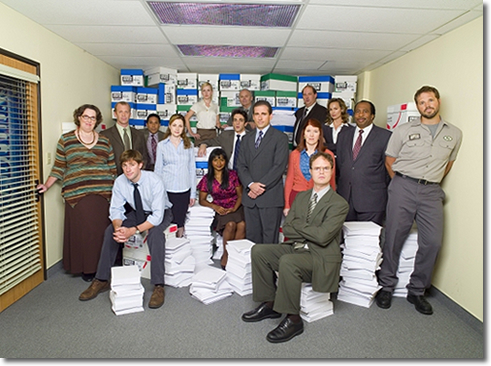
The Office of Dunder Mifflin

Right now I'm watching the Halloween episode of the award-winning comedy the Office and laughing my guts out. The Office is based on a similar British series of the same name. Even though I had heard of this unique and wacky sitcom (can one really call it a sitcom?) the Office, more than a year ago, I only started to watch it last year. And I must say that the Office series is brilliant. No wonder it has got so many awards. The show even has its own website here. The unique aspect about this is that the camera is hand held and the action seems all spontaneous. The actors at times look at and talk to the camera giving an indication of a third party being present.


Each of the characters in the Office have some quirk or the other and they are hilarious in their own right. Jim and Pam's awkward and secret (or not so secret) dalliance with each other. Dwight Schrute's paranoia, his constant butt-licking of the boss, and his one-upping of the other employees of Dunder Mifflin. The never-ending jokes by the boss on Phyllis (the fat woman) and pseudo-racist jokes on Stanley - the proverbial black guy in the office. And of course how can you forget the boss, Michael Scott played by Steve Carell. He amazingly plays the irritating boss who constantly tries to put the best side of him to the camera and how he supposedly cares for the employees. His attempts at modesty and self-effacing are hilarious, partly because that is what happens in real life too. Each episode Michael faces a different situation which he somehow manages to deal with. Another interesting aspect of work life depicted in this show is the relation between the management and the shop floor. Michael Scott unwaveringly tries to try out his motivation techniques on the workers in the warehouse who obviously don't care a shit about his attempts.

Let me finish watching this episode now. Did I mention that I have a Corporate Finance exam tomorrow? Oh well. Forget F.R.I.E.N.D.S.; go watch the Office, especially if you think that after an MBA, things will be all hunky dory in the office.

Saturday, February 16, 2008

Challenges in entrepreneurship, anyone?

S T Coleridge said in his immortal poem, "Water water everywhere, nor any drop to drink."

I say, "Jargon jargon everywhere, not one in my head did sink."

Tuesday, February 12, 2008

SWOT of stubborn and flexible people

Let's assume that all the people in the world can be divided into two categories - flexible and stubborn. This division is on the basis of their ability or willingness to learn something other than their domain of knowledge. Now, the strength of the stubborn people is their expertise and confidence in their domain. However their weakness is that they are probably afraid of failing in the other domains. That is why they stick to their own field and possibly sometimes disparage the other fields.

Now if we take the flexible people, their strength is their ability and confidence to adapt to other domains. But their weakness is a possible lack of expertise in their own domain. That is partly the reason they readily accept to try out various other fields.

I guess each has something to learn from the other

Monday, February 11, 2008

Lack of self control and what I plan to do about it

Lack of self control is something which one faces some time or the other in life. For me, it is a continuous battle. Mostly I lose the fight, sometimes I manage to save my face. Be it in anything as simple as sleeping for one hour less or not having that extra cold drink or piece of pastry, I totally lack control. I shift into short term mode and rarely think of the negative long term effects which this would have on my body.

Its funny when you read about all good habits but you lack to follow them yourself and one day you wake up and see that you have this disease which you could have avoided all the time along by practicing a little bit of moderation. As I said for me, cure seems to be the easier alternative than prevention much to the consternation of the people who care. I make up some excuse or sometimes blatantly lie about what I did or what I failed to do to prevent such an occurrence. I blame the weather or my genes if I fall sick. But I know I'm lying and I know I'm suffering. I know that my self respect will increase only when I learn to say no to things, and start doing things which are beneficial to me in the long run. So here goes nothing.

To start with I'll concentrate on what I eat. No more stuffing (junk) food into my stomach mercilessly. I eat only when required. Let's push my limits. If nothing else, I'll learn one thing from Total Quality Management. From today I follow Toyota's 5 whys approach. Before stuffing anything in my mouth, I will ask myself 'why.' On one hand while I may not be able to wait to ask 5 questions but I will definitely ask myself one the necessity and requirement of anything I put in my mouth. There are many people who can validate whether I'm doing this diligently or not. I may not lost 10 kgs (which I need to) using this method but I'll at least set an example for myself on which to test other things as well.

In related news, I came across another example which proved that getting a 9.x CGPA doesn't get you commonsense free with it.

Wednesday, January 30, 2008

A laborious MBA

'A manager must learn how to perform under pressure.'
'A leader must learn to manage deadlines.'

This is a common refrain given to justify the heavy workloads given in B-schools. But according to me, focusing on urgency and deadlines is not the only thing for a manager. What this would do is to create firefighters and crisis managers. And not all people perform to their fullest under pressure. Being a manager is not only being able to perform under pressure but being able to create something different, something which no one else has thought up of. And genius is something which normally needs patience. It may happen once or twice in the middle of the night but mostly it needs to be cultivated patiently. When you give assignments and ask students to submit them a couple of days later, sometimes two to three assignments in a day when you consider all the subjects, you rob the students of their creativity. In their haste to 'get it done', they do a shoddy job and mostly copy it from seniors or from the net. Just type out a sentence or two from the case in Google and you'll, in most cases, get a solved version of the same from the Internet. There is a difference in a presentation given by copying sentences from the net and breaking them down into bullet points and a presentation made after reading articles or reports and by developing unique insights from the group. There is a difference in a presentation given by dividing the slides among the members and a presentation made together after brainstorming and arguing the possible alternatives. The presentations have become so cliched that I can safely bet with my eyes closed that the slide after the title slide will have an Agenda and the last slide will be a Thank You slide.

One may be able to fool some of the people all the time, but not all the people all the time. This shortcoming easily glares up in the corporate world. When you do this in front of a customer, he or she is most likely to see through the bull. What needs to be done is to make the MBA course thorough but not urgent/laborious. Give us the motivation to read the Economist, to read McKinsey reports, to read HBR. Make us study them. Do not give the case studies two three days before the submission. Give them at the beginning of the quarter/semester. Set a deadline, preferably at least two weeks before and give the students the time and space to work out something. Point them to reports or articles which will help them out in their quest. Let the students know that original thoughts will be appreciated. And yeah, most important of all, set up a peer evaluation. This is most important to ensure that everyone works or at least shows up for the meeting. (<-- This deserves a separate post)

Appendix A: Here's just an example of the number of cases which might crop up in an average week.
Financial Management - 1 case per week. 2-3 pages only but impossible to decipher.
TQM - 1 case per fortnight (as of now) 5-6 pages. Somewhere on the easier side but supremely boring.
OM - The mother-in-law of all cases. One case per week, which will soon scale up to two. Ranges from between 4-10 pages long. Totally hopeless unless you're an operations freak.
MIS - The best and the simplest to understand but (yes, I'm an IT engineer, but still) painfully long. Two cases per week (at 8am), each case 14-20 pages.

That works out to around 5-6 cases every week. Couple that with average of 6 hours of class daily and surprise quizzes always around the corner. Where is the time to smell the roses?

Wednesday, January 09, 2008

Sunrise over Ascendas


taken from IIT Madras

Saturday, January 05, 2008

Flog them bastards

"Two recently married women molested in front of a posh hotel in Juhu, Mumbai on New Year's Eve." As I write this, one dilemma comes to mind. Who the hell is to blame? The hotel authorities would say that the incident didn't happen on their property. The police would say they were already overworked during the New Year's and were short of men. Men. That is a word which we will have to redefine. The people who did it were not certainly men. Probably under the influence of alcohol, they became something undefinable and something dispeakable. And as if eve-teasing wasn't bad enough, these people have become so bold so as to openly grope and fondle women. And I speak not of this particular incident, but the general rising trend of such incidents which are becoming more and more common every passing day. What is more horrifying is that on the Net, people are actually searching for the pictures that the photographers have clicked rather than for the actual news item itself. And we say that we empathize with the victims. Sad, isn't it?

Now that the police have arrested some of the suspects, a long winded procedure will start the end of which is uncertain. To protect their identity and their self-respect, the victims may probably drop the case. Sometimes it feels to me that the corporal punishment practiced in some of the Gulf countries seems to be the best and the quickest method to punish the perpetrators. A severe flog in public on their naked, exposed skin will bring them back to reality and hopefully incapable of doing such a crime again, both mentally and 'physically.'


An interesting coincidence. The song playing in the background as I write this, 'Where is the love?'

Tuesday, January 01, 2008

Why I may never get top grade

I found a very interesting article online which compared attributes of high achievers, gifted learners and creative thinkers. To a layman the three may not seem all that different but apparently they are, and hugely so. Here are two important extracts which more or less sum up the article.

...the teacher announces an assignment, and the high achiever quickly tries to determine what the teacher most wants so he can please and satisfy the teacher's intentions: "What do you really want?" The gifted learner ponders what to do that would most interest her as she learns: "What I would like to do is..." Simultaneously, the creative thinker's mind begins to race with all of the diverse and varied possibilities that could be explored...

And,

...the teacher poses a question to the class. The high achiever is delighted because he knows the answer and is in control: "Oh, I know that answer!" The gifted learner considers multiple nuances and alternative perspectives: "The question could mean..." or "It might suggest..." or "Another way to say that is..." or "Yah, but..." The creative thinker is still obsessed with the seemingly endless possibilities of the earlier assignment, concentrating so much on his ideas that he completely misses the teacher's question...

I guess I have a pretty good idea where I belong. 75% creative, 25% gifted learner. And that pretty much sums up where I stand.

Here's the article (High Achiever, Gifted Learner, Creative Thinker)
. Specifically, the table at the end of the article is interesting and useful.

The creative thinker

  • Wonders
  • Daydreams
  • Overflows with ideas, many of which will never be developed
  • Shares sometimes conflicting opinions
  • Questions the need for mastery (yeah man)
  • Prefers the company of creative peers but often works alone
  • Is independent and unconventional
  • Is original and continually developing
  • Improvises
  • May not be motivated by grades (he he)
QED

  © Blogger template 'Totally Lost' by Ourblogtemplates.com 2008

Back to TOP